

The Hidden Cost of Close-Enough: Why Inconsistent Flight Geometry Is Draining Profits From Bulk Material Handling

RoboHelix Helical Flight Forming Robotic Machine
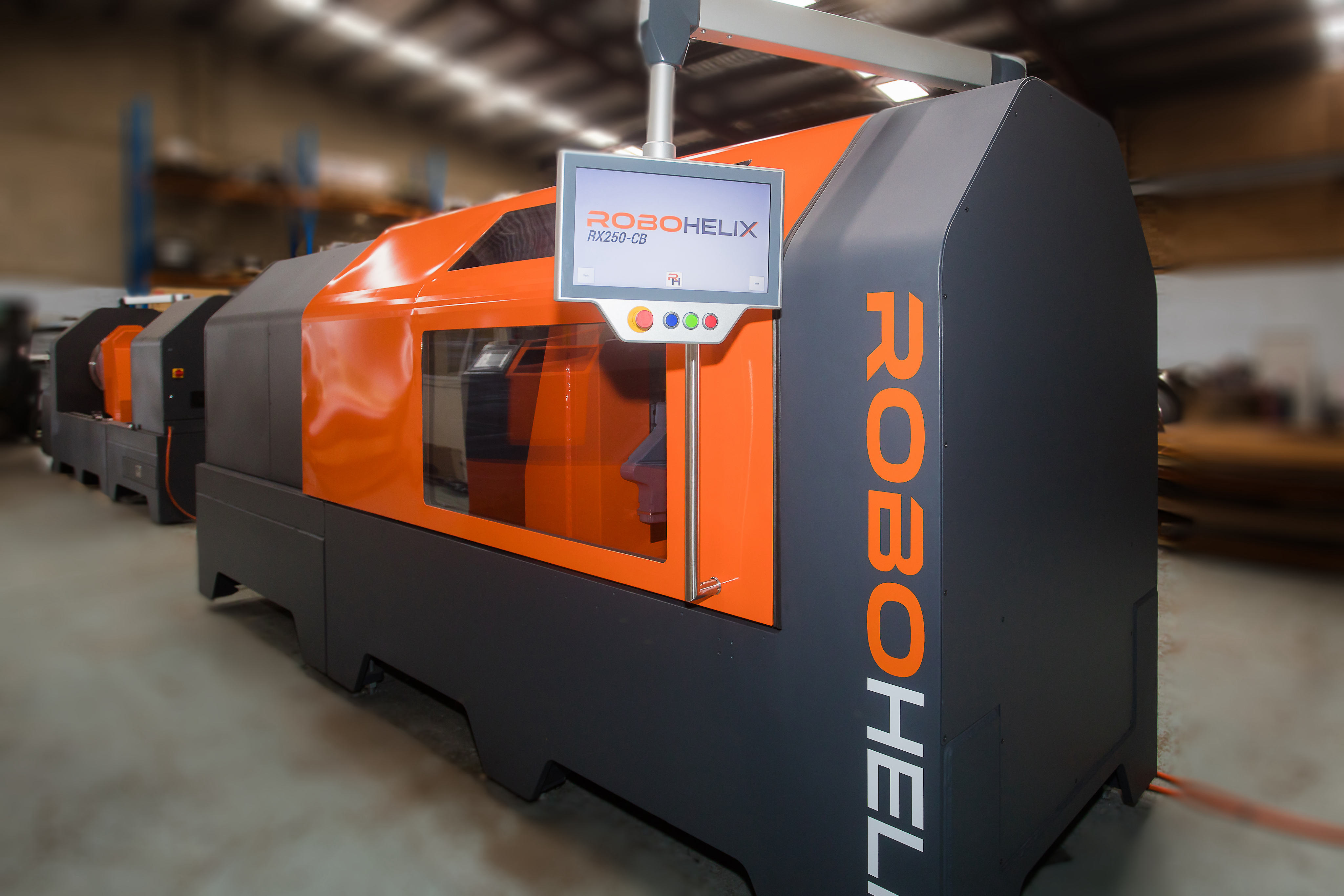
RoboHelix Machine
RoboHelix says the fix for premature auger and screw conveyor failure isn't more inspection downstream — it's controlling geometry at the point of forming
The biggest benefit for us is the much higher accuracy in the final geometry of the flights compared to other technologies”
TX, UNITED STATES, August 31, 2026 /EINPresswire.com/ -- A screw conveyor at a grain terminal starts vibrating six months ahead of schedule. A mining auger wears unevenly and needs replacing prematurely. A concrete mixer's flighting throws off balance just enough to chew through a bearing. On their own, each incident reads as routine wear and tear. Taken together, engineers who investigate these failures say they often trace back to a problem that starts long before the part ever reaches the field: small, hard-to-see inconsistencies in the geometry of the flight itself.— RoboHelix client, Czech Republic
Helical flights — the spiral blades at the heart of augers, screw conveyors, screw piles and mixers — have traditionally been shaped by hand-guided die-forming using opposing hydraulic presses, a process that leans heavily on an individual operator's technique, feel and skill level. Metal doesn't cooperate uniformly: steel sheets differ in consistency in every batch. So the final pitch, diameter and profile can drift a little from one flight to the next — even within the same production run. Those variances are often too small to catch on a visual inspection, but they compound once the part is welded to a shaft and put into service: uneven load distribution, added vibration, accelerated bearing and wear-liner wear, and higher energy draw to move the same material.
Unplanned downtime is already one of the costliest problems in industrial operations. A 2025 reliability study found unplanned downtime is costing manufacturers as much as $852 million a week across the sector. Flighting failures are rarely the headline cause of a shutdown — but for operators running mining, agriculture, construction or food-processing equipment around the clock, a component that fails early is a component that was never going to be cheap, whatever line item it shows up under.
RoboHelix, the manufacturer of the world's first fully automated robotic flight-forming machine, argues that geometry variance is fixable at the source rather than caught later. Instead of an operator's hands and a press's "feel," RoboHelix's machines use an 8-axis robotic arm, directed by the company's proprietary HelixNinja® software, to grip a flat metal disc and stretch it into a precise helical shape in a single, repeatable, computer-controlled operation. Because the forming parameters are generated and executed by software rather than judged by hand and adjusted for spring-back on the fly.
"The biggest benefit for us is the much higher accuracy in the final geometry of the flights compared to other technologies," said one fabricator in the Czech Republic who switched to RoboHelix's robotic forming process, in comments shared with the company.
"When every flight comes off the machine built to the same specification, fabricators stop passing along variations they can't see — and their customers stop paying for it in downtime, warranty claims and unplanned replacements," a RoboHelix spokesperson said.
The company's modular RX125, RX250 and RX500 machines cover helical flights from very small precision flights up to extra-large, heavy and thick flights. The flagship RX500 forms flights up to 1,500 mm in diameter with pitch up to 1,700 mm, in steel, stainless steel, and high-strength alloys up to 25 mm (1 inch) thick — sizes that have historically been the hardest to hold to consistent tolerance using manual methods. RoboHelix machines are in operation across multiple countries, serving fabricators supplying the agriculture, mining, construction, food-processing and renewable-energy sectors.
For fabricators and OEMs who build to a customer's specification once and then live with the field consequences for years, RoboHelix states that “precision built in at forming costs less than failure diagnosed on site”.
RoboHelix is offering to run a side-by-side geometry comparison on a fabricator's own flight specification — forming a sample on an RX-series machine so engineering and quality teams can measure the tolerance difference themselves rather than take the claim on faith. Fabricators, distributors and trade media can request a sample run, an in-person demonstration or a video walkthrough at robohelix.com.
About RoboHelix
Founded in 2015, RoboHelix designed and built the world's first fully automated robotic flight-forming machine, replacing a manual process that traditionally required roughly 45 minutes of setup per job with a fully automated cycle completed in seconds. RoboHelix holds international patents on its forming technology and exports its RX125, RX250 and RX500 machines to fabricators in multiple countries across agriculture, mining, construction, food processing and renewable energy. Learn more at robohelix.com.
Media Manager
RoboHelix
sales@robohelix.com
Visit us on social media:
LinkedIn
Facebook
YouTube
X
Legal Disclaimer:
EIN Presswire provides this news content "as is" without warranty of any kind. We do not accept any responsibility or liability for the accuracy, content, images, videos, licenses, completeness, legality, or reliability of the information contained in this article. If you have any complaints or copyright issues related to this article, kindly contact the author above.
