

Audio Equipment Market Forecasted to Surpass USD 31.58 Billion with 7.50% CAGR by 2035.
Audio Equipment Market
Audio Equipment Market Size, Share and Research Report By Product Type (Mixers, Amplifiers, Microphones, Audio Monitors, and Other Product Types), By End User
Audio Equipment Market is expanding as rising demand for high-quality sound, smart devices, professional audio solutions, and immersive entertainment drives technological innovation.”
NEW YORK,, NY, UNITED STATES, September 7, 2026 /EINPresswire.com/ -- ➤ Market Overview— Market Research Future (MRFR)
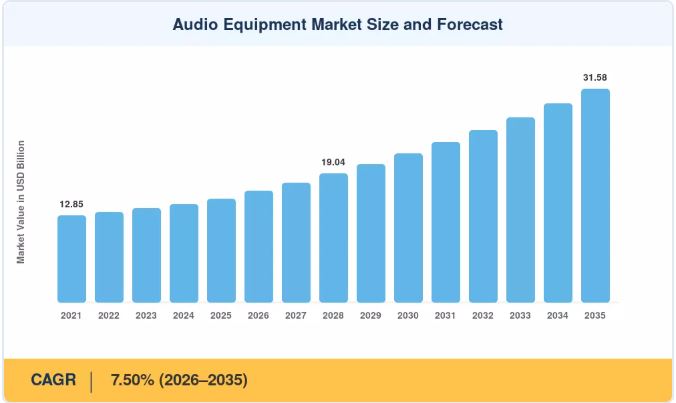
The Audio Equipment Market closed 2025 at USD 15.32 billion and enters the forecast window at USD 16.47 billion in 2026, climbing to USD 31.58 billion by 2035 at a 7.50% CAGR. This expansion reflects rising demand for wireless headphones and earbuds, smart speakers, soundbars, automotive audio systems, and professional monitoring equipment across consumer, commercial, and automotive end uses.
Asia-Pacific commanded 33.5% of the Audio Equipment Market in 2025, supported by large-scale manufacturing in China, aggressive 5G rollouts, and rapidly rising domestic consumption. Countries across the region are combining production scale with growing first-time buyer demand, giving providers a dual advantage of supply and consumption growth.
North America accounted for 28.0% of the market in 2025, driven by a strong content-production ecosystem, enterprise AV procurement, and premium consumer adoption cycles. The United States remains the anchor of the region, with steady spending on streaming-content equipment, home-theater upgrades, and hybrid-work conferencing hardware.
The Middle East & Africa held a 6.5% share of the Audio Equipment Market in 2025, an estimated USD 1.0 billion, supported by hospitality and venue AV construction, smart-city infrastructure programs, and mobile-first audio adoption. Investments tied to large-scale entertainment and tourism development are expanding demand for both professional installations and portable consumer devices.
Download Sample Pages of Research Overview -
https://www.marketresearchfuture.com/sample_request/11809
➤ Audio Equipment Industry Landscape
Audio equipment spans the hardware and embedded systems used to record, amplify, transmit, and reproduce sound, including speakers, soundbars, headphones, earphones, mixers, amplifiers, microphones, and audio monitors. As listening habits shift toward wireless and connected formats, manufacturers are redesigning products around software-defined signal paths, adaptive processing, and multi-device ecosystems rather than fixed analog components.
The expansion of streaming platforms, podcasting, gaming, and hybrid-work communication is broadening the base of buyers who need reliable, high-fidelity sound. At the same time, automakers, enterprises, and venue operators are treating audio as a core differentiator rather than an afterthought, reinforcing demand across consumer, commercial, and automotive channels alike.
➤ Wearable Technology Market
The Wearable Technology Market is a relevant topical authority keyword because a growing share of wearable devices, including true wireless earbuds, smart glasses with audio, and fitness headsets, depend on the same miniaturized drivers, batteries, and wireless chipsets that define modern audio equipment. Manufacturers increasingly design audio components to double as always-on wearable accessories rather than standalone listening devices.
The connection between wearable technology and audio equipment illustrates how sound hardware is becoming embedded in everyday personal devices rather than confined to dedicated speakers or headphones. As consumers seek continuous connectivity, health tracking, and voice-assistant access from what they wear, demand for compact, low-power audio components is expected to rise alongside broader wearable adoption.
➤ Key Growth Drivers
The shift toward wireless listening remains a central growth driver for the Audio Equipment Market. Consumers are replacing wired headphones and traditional stereo systems with Bluetooth earbuds, multi-room speakers, and app-controlled soundbars that offer greater convenience and integration with smart-home ecosystems. This transition is encouraging manufacturers to prioritize battery efficiency, low-latency codecs, and seamless device switching.
The growth of content creation and hybrid work is another significant factor supporting industry expansion.
Podcasters, streamers, and remote professionals increasingly require microphones, audio interfaces, and conferencing hardware capable of studio-quality output. This has blurred the line between consumer and professional audio segments, prompting vendors to release hybrid products that serve both markets.
➤ Wireless Connectivity and Smart Audio Integration
Wireless-Bluetooth connectivity accounted for the majority of Audio Equipment Market revenue in 2025, aided by newer low-energy standards that improve codec efficiency and allow multiple simultaneous audio streams. This is especially important for headphones, home theaters, and portable speakers that rely on stable, low-latency connections.
Wi-Fi and multi-room streaming protocols are also expanding demand, as households increasingly connect several speakers into a single, app-managed listening environment. Voice assistants, adaptive equalization, and personalized sound profiles are turning everyday audio devices into connected hubs within the broader smart-home and Internet of Things ecosystem.
➤ Automotive and Immersive Audio Demand
Automotive OEM and aftermarket audio is expanding as electric vehicles remove combustion-engine noise and make interior acoustics a more prominent purchase consideration. Automakers are partnering with established audio brands to offer premium, software-updatable sound systems as a differentiator rather than a secondary feature.
Immersive and spatial audio formats are also reshaping demand across home entertainment and gaming. As streaming platforms and game studios adopt head-tracked and object-based audio, manufacturers are upgrading soundbars, headphones, and receivers to support these formats, creating an additional replacement cycle across the installed base.
Buy Now Get Comprehensive Market Insights -
https://www.marketresearchfuture.com/checkout?currency=one_user-USD&report_id=11809
➤ Product Segmentation
The Audio Equipment Market can be segmented across speakers and soundbars, headphones and earphones, mixers, amplifiers, microphones, and audio monitors. Speakers and soundbars remain the largest revenue contributor, benefiting from smart-assistant integration and home-theater replacement cycles, while headphones and earphones represent the fastest-growing category as active noise cancellation and hearing-health features move into mainstream price tiers.
Mixers, amplifiers, and microphones continue to serve professional and prosumer buyers who require dependable performance for live events, broadcasting, and content production. Demand for these categories is closely tied to the growth of independent content creation and the expansion of live entertainment and corporate events.
Enterprise and Consumer Adoption Trends
Enterprises are increasingly standardizing on conferencing microphones, beamforming soundbars, and networked audio systems to support hybrid meeting spaces, huddle rooms, and hot-desking environments. What was once a niche IT purchase has become a routine procurement line item as organizations reconfigure offices around flexible collaboration.
Individual consumers, meanwhile, are consolidating around single-ecosystem audio setups that pair a primary soundbar or speaker with companion devices controlled through one app. First-time buyers in emerging markets are also expanding the entry-level segment, giving manufacturers a volume-driven growth pathway alongside premium upgrades in mature markets.
➤ Regional Insights
Asia-Pacific led the Audio Equipment Market with a 33.5% share in 2025, reflecting its dual role as the manufacturing base for a majority of global audio hardware and a fast-growing consumption market. Urbanization, rising disposable income, and expanding 5G infrastructure across China, India, and South Korea continue to support both production and domestic demand.
North America held a 28.0% share in 2025, anchored by a mature content-production ecosystem, strong enterprise AV spending, and consistent premium-product adoption. Canada and Mexico are contributing through broadcast infrastructure upgrades and expanding electronics assembly operations respectively.
Europe represented 24.0% of the market in 2025, supported by automotive OEM audio integration, a robust live-events sector, and regulatory requirements pushing manufacturers toward recycled materials and repairable product design. Germany remains the region's largest single market, reflecting its automotive-audio supply chain strength.
Emerging Opportunities
One of the most significant opportunities involves spatial and immersive audio monetization. As streaming platforms and gaming ecosystems adopt head-tracked, object-based sound formats, hardware that supports these codecs can command meaningful price premiums, creating an upgrade cycle across headphones, soundbars, and receivers.
Another opportunity lies in hearing-health convergence. Headphones capable of in-ear audiometric testing and automatic calibration are blurring the line between consumer audio and medical-grade amplification, allowing manufacturers to reach a broader addressable base through clinically adjacent positioning.
➤ Key Challenges
Despite strong growth potential, the industry faces several challenges. Reliance on rare-earth magnets for high-fidelity transducers creates supply-chain concentration risk, while semiconductor lead times for Bluetooth chipsets and audio processors continue to run above pre-pandemic norms, slowing new product launches.
Counterfeit products remain a persistent concern, particularly in mid-range and entry-level categories where brand authentication infrastructure is weaker. Price sensitivity in emerging markets and regulatory fragmentation around wireless spectrum and sustainable-materials requirements add further complexity for manufacturers operating across multiple regions.
➤ Future Outlook
The Audio Equipment Market is expected to maintain steady expansion as wireless listening, smart-home integration, and automotive infotainment continue to broaden the categories of devices that rely on advanced sound hardware. Growth from USD 15.32 billion in 2025 to USD 31.58 billion by 2035 represents a substantial increase in demand across consumer, professional, and automotive channels.
Future development will increasingly center on AI-driven adaptive audio processing, spatial and immersive formats, software-defined automotive sound systems, and sustainable product design. Providers that combine technical performance with connectivity, personalization, and responsible manufacturing practices will be well positioned to capture long-term opportunities.
Browse Full Report Details -
https://www.marketresearchfuture.com/reports/audio-equipment-market-11809
➤ Key Takeaways
The Audio Equipment Market is being shaped by the shift to wireless listening, the growth of content creation and hybrid work, automotive infotainment electrification, and rising demand for immersive sound formats. Asia-Pacific remains the leading regional contributor, while North America and Europe continue to anchor premium, professional, and automotive demand.
The integration of AI-driven processing, spatial audio, and connected ecosystems will increasingly redefine how audio devices are designed and used. At the same time, related technology areas such as the Wearable Technology Market demonstrate the growing overlap between audio hardware and everyday connected devices. As consumers and enterprises prioritize sound quality, convenience, and personalization, audio equipment is expected to remain a strategic component of consumer electronics and enterprise technology alike.
➤ Frequently Asked Questions
Q - How do tariffs on Chinese-manufactured audio components affect global pricing?
A - U.S. Section 301 tariffs of 7.5–25% on Chinese audio imports raise landed costs, pushing brands to diversify assembly into Vietnam and India. End-consumer prices for affected categories have risen 8–12% since 2023
Q - What distinguishes Bluetooth LE Audio from classic Bluetooth for audio buyers?
A - LE Audio uses the LC3 codec for better sound quality at half the bitrate, supports multi-stream for true stereo earbuds, and enables Auracast broadcast sharing. It requires compatible hardware released after mid-2023
Q - How is the shift to plant-fiber speaker diaphragms affecting acoustic performance?
A - Cellulose-nanofiber and bamboo-pulp cones now match polypropylene in frequency response within ±1.5 dB. Manufacturing costs remain 15–20% higher, but ESPR compliance incentives are closing the gap
.➤➤➤ Industry Analysis Reports by Market Research Future:
Fire Protection System Market-
https://www.marketresearchfuture.com/reports/fire-protection-systems-market-4676
Debit Card Market-
https://www.marketresearchfuture.com/reports/debit-card-market-23925
Vrf Systems Market-
https://www.marketresearchfuture.com/reports/vrf-system-market-10128
India Facial Recognition Market-
https://www.marketresearchfuture.com/reports/india-facial-recognition-market-47027
Remotely Operated Vehicles Market-
https://www.marketresearchfuture.com/reports/remotely-operated-vehicle-market-7023
Volte Technology Market-
https://www.marketresearchfuture.com/reports/volte-technology-market-1402
Security Cameras Market-
https://www.marketresearchfuture.com/reports/security-cameras-market-7744
Spain Access Control Market-
https://www.marketresearchfuture.com/reports/spain-access-control-market-44653
Network Engineering Services Market-
https://www.marketresearchfuture.com/reports/network-engineering-services-market-11087
Esg Finance Market-
https://www.marketresearchfuture.com/reports/esg-finance-market-24428
Market Research Future
Market Research Future
+1 855-661-4441
email us here
Legal Disclaimer:
EIN Presswire provides this news content "as is" without warranty of any kind. We do not accept any responsibility or liability for the accuracy, content, images, videos, licenses, completeness, legality, or reliability of the information contained in this article. If you have any complaints or copyright issues related to this article, kindly contact the author above.
